


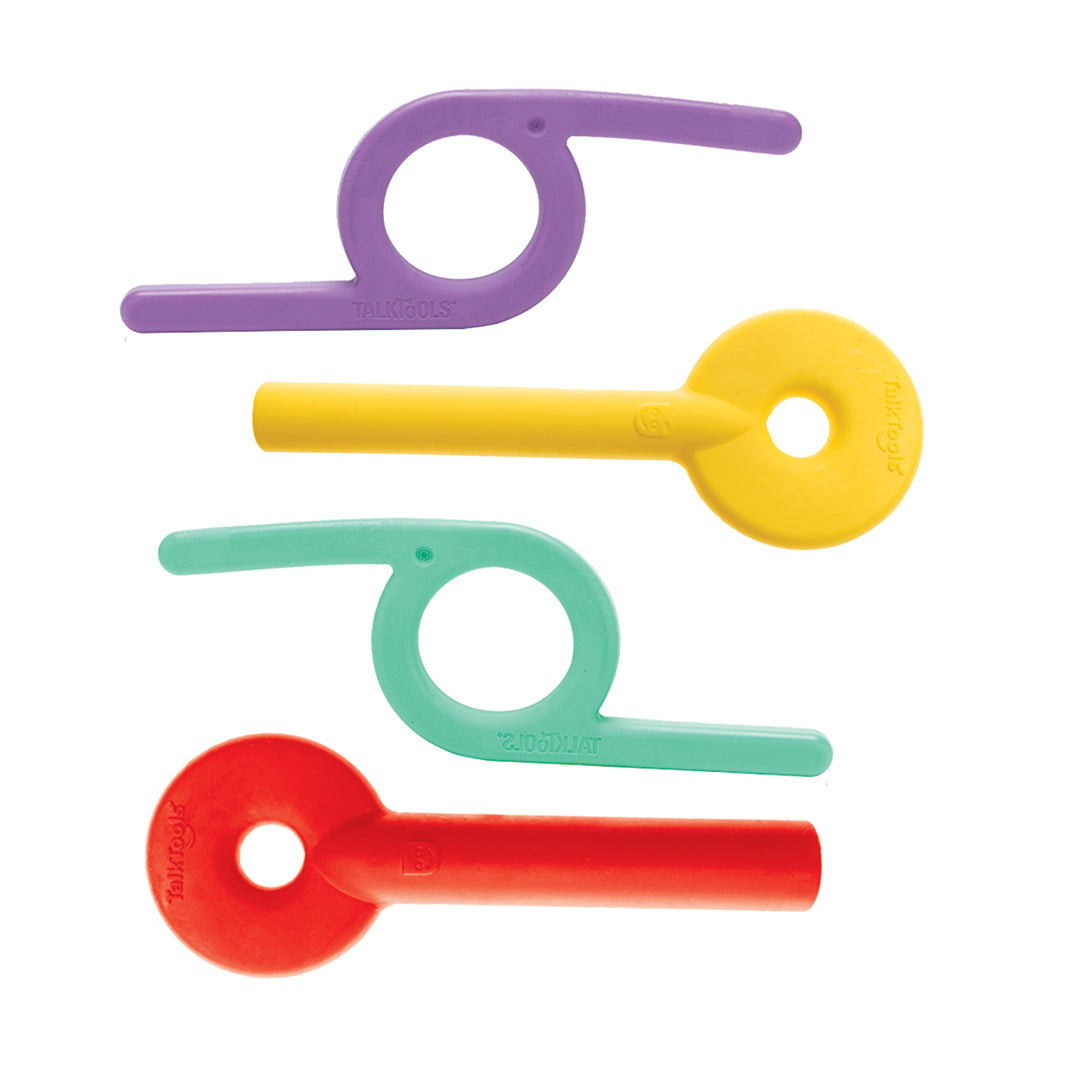





One handle, many possibilities
The handle is what makes this system clinically different from static oral tools, so it’s worth understanding before getting into individual tip types.
The Sensi vibrates. Every tip attaches via a quarter-turn mechanism and receives vibratory input during use. That vibration isn’t incidental. It changes what the client’s nervous system experiences during the exercise. For hypersensitive clients it can reduce oral defensiveness, lowering the perceived threat of intraoral contact before any resistance or placement work begins. For clients with low tone or reduced proprioceptive registration, it amplifies the sensory signal from jaw and oral movement, giving the brain more to work with during each exercise. These are opposite clinical problems that the same tool addresses through the same mechanism.

TalkTools® Sensi® Rechargeable Handle
Compatible with all tips via the quarter-turn attachment. The Rechargeable version has four vibration profiles: Lo, Hi, Pulse Low, and Pulse High, meaning vibration intensity and tip selection are two variables you can adjust independently within a session. The standard Sensi handle works with all tips at a single vibration setting.
Think of the vibration setting and the tip as two separate dials rather than one combined thing. You can increase vibration without changing the tip, and swap the tip without touching the vibration. Keeping those variables separate is what makes the system flexible enough to adapt within a session as the client’s tolerance shifts.
Bite Tube Tips: the hierarchy you already know, with vibration
If you already use the TalkTools Bite Tube Set, the Sensi Bite Tube Tips won’t ask you to learn anything new. Same four-level progression, same advancement rule: two controlled compressions without compensatory movement before moving up. The only difference is that vibration from the handle is coming through the tip while the client works.
That vibration matters most for two groups. First: clients whose oral defensiveness means they pull away the moment a bite tube gets near the molars. The vibration can reduce that defensive response and open a window in which the jaw grading work actually becomes accessible. Second: clients with low tone whose proprioceptive feedback from bite compression is too faint to drive motor learning reliably. The vibration turns up that signal.
A lot of clinicians end up using both. The Sensi version handles the early tolerance-building phase; the standard set comes in once the client can sustain jaw grading without needing the extra sensory input. That’s a common and sensible approach.


The four-level progression
Two controlled compressions without compensatory movement at each level before advancing. Sessions can include more than one level depending on fatigue and what you’re working toward.
Jaw Placement Tips: vibration at a specific position in the jaw’s range
Jaw placement tips don’t work through resistance. They work through position. You place them at a specific vertical jaw height and deliver vibration there to build awareness and motor control at that point in the range.
Three positions: high (near the upper molars), medium (mid-range), and low (open-jaw). You’ll recognize these from standard OPT assessment. Each comes in a firm and a soft version. Use the soft variants when a client isn’t ready for firm intraoral contact at a given position. Same target, gentler surface, with a natural transition to the firm version as tolerance develops.
The Ridge Tip is in its own category: it targets the alveolar ridge rather than a vertical jaw position. Reach for it when tongue-tip elevation or lingual-alveolar placement for sounds like /t/, /d/, /n/, or /l/ is the goal.


Spoon Tips: when utensil contact is the barrier
The spoon tips bring the handle’s vibration into feeding sessions. There are two main reasons to reach for them over a standard spoon. One: the client is working on accepting utensil contact and a regular spoon is triggering a defensive response, so vibration through the spoon surface can help reduce that and make the feeding interaction more workable. Two: the client has reduced oral registration and isn’t getting enough sensory information from a standard spoon to support lip closure or tongue movement during presentation.
Work through the profiles roughly as you would any desensitization sequence: Soft Spoon Tip first for clients with significant feeding sensitivity, textured variants when more sensory input is needed, Pointed Spoon Tip when precision of placement is the goal.
The Tip Grip is worth knowing about: it holds any spoon or chewy tip without the vibrating handle. It lets you work with a specific tip shape when vibration isn’t yet indicated, or introduce the shape first before adding the vibratory layer.


Desensitization Tips: where most hypersensitive clients need to start
Here’s the thing about the bite tube hierarchy: a client who can’t tolerate intraoral contact at the molars isn’t a candidate for it yet. The desensitization tips are what you use to build that tolerance first.
They deliver vibration without any bite resistance or placement demand. You’re not asking the client to do anything with their jaw. You’re introducing controlled sensory input in a sequence they can actually tolerate. A smooth round tip at low vibration is typically the least threatening thing you can place intraorally. From there you can introduce texture, move further back, and eventually work toward placement or bite tube contact. That progression can happen within a single session or over multiple sessions. The client’s response sets the pace.
The Brush Tip works a little differently. It delivers vibration through a soft bristle surface and is used for perioral and gum stimulation work, and for pre-feeding routines where a very soft first contact is needed before any shaped tip goes intraorally.


Chewy Tips: not a softer version of the bite tube
The most common mix-up with the Sensi system: chewy tips and bite tube tips are different tools for different goals. They’re not interchangeable, and chewy tips are not a lower-resistance substitute for bite tube work.
Bite tube tips are a jaw grading exercise. You follow a hierarchy, work in dosage, and you’re building specific masseter strength and vertical jaw range. Chewy tips are for chewing development and sensory regulation. When a client is chewing on their clothing, biting their nails, or chewing on their tongue, they’re usually seeking jaw proprioceptive input that isn’t being met through typical daily activities. A chewy tip with vibration can address that need more directly than putting them through a resistance hierarchy.


How a session might actually flow
In practice, a session often moves across multiple tip types, especially with complex clients. Here’s how that arc typically looks for a hypersensitive client who eventually needs jaw grading work.
Frequently Asked Questions
Do I need the Rechargeable, or is the standard Sensi fine?
The standard Sensi works with every tip and is a capable tool. The main reason to choose the Rechargeable is if you want to adjust vibration intensity within a session. Its four profiles (Lo, Hi, Pulse Low, Pulse High) let you change the input level independently from the tip. For clients whose tolerance shifts during a session, that flexibility matters. If your caseload doesn’t require fine-grained vibration control, the standard version is often sufficient.
Is vibration safe for clients with oral hypersensitivity?
Yes, when it’s part of a planned clinical program. Start at the lowest vibration setting, use the least demanding tip (usually the Round Tip or Brush Tip), and work anteriorly before moving posteriorly. Vibration can actually reduce defensiveness in hypersensitive clients rather than making it worse. The key is pacing and not overloading the system. If a client shows a strong aversive response, back off on the location or vibration level and build more slowly.
How are tips cleaned between clients?
All tips are dishwasher-safe and made from medical-grade, BPA-free, latex-free, lead-free, and phthalate-free material. The quarter-turn attachment makes removal quick. Follow your standard infection control protocols with surface-appropriate disinfectants between client uses.
My client can’t tolerate standard bite tubes. Will the Sensi version actually help?
Often, yes, but not because it’s a softer bite tube. The resistance levels are the same. The difference is the vibration. For clients who avoid bite tube contact because of oral defensiveness, the vibration can reduce that defensive response and make the exercise tolerable. That said, if the client isn’t ready for molar contact at all, start with desensitization tips first. Work toward bite tube contact as a later step rather than starting there.
Can I use the Sensi Bite Tube Tips and the standard Bite Tube Set in the same program?
Yes, and it’s a common approach. Use the Sensi version when vibration is helping tolerance or proprioception; use the standard set once the client can sustain jaw grading without that extra input. Some clients stay on the Sensi version throughout. What drives the choice is the clinical picture, not a rule about which tool is more advanced.
How do I know when to advance to the next resistance level?
Same rule as the standard hierarchy: two controlled compressions at a level without compensatory movement. Watch for jaw sliding, jutting, or asymmetrical biting patterns before calling a progression. If you’re seeing those, stay at the current level and work on quality before adding resistance.
Are Bite Tube Tips useful for adult clients too?
Yes. Adults recovering from oral surgery, managing acquired neurological changes, or working on post-stroke jaw rehabilitation sometimes have limited tolerance for the sustained effort jaw grading requires. Vibration changes the proprioceptive quality of the work in ways many of those adults find more tolerable, particularly at the lower resistance levels. The soft jaw tips are also worth considering for this group before moving to the firm variants.
How are jaw placement tips different from bite tube tips?
Bite tube tips work through resistance: the client bites down and the tube pushes back. Jaw placement tips work through position: you place the tip at a specific jaw height and deliver vibration there without asking the client to bite against anything. The clinical goals are different, and the two tip types aren’t interchangeable within a jaw grading program.
Should I always start with the soft jaw tips before moving to the firm ones?
Not necessarily. It depends on the client’s tolerance. If you’ve already established intraoral contact through desensitization and the client is managing firm contact anteriorly, you might go straight to the firm jaw tip. The soft variants are there when firm intraoral contact is not yet tolerated, or when you’re introducing a new placement position and want a gentler start. Let the assessment and session response drive that call.
What is the Ridge Tip and when do I use it?
The Ridge Tip targets the alveolar ridge, the bony ridge just behind the upper front teeth that serves as the contact point for /t/, /d/, /n/, /l/, and /s/. Use it when tongue-tip elevation or lingual-alveolar placement is the speech production goal and the client needs tactile-vibratory input at the ridge to build awareness and movement accuracy at that location.
What order should I introduce desensitization tips in?
A typical sequence: Round Tip or Brush Tip at Lo vibration for perioral and anterior intraoral exposure, then Round Textured Tip or Smiley Tip for varied surface input, then a soft jaw tip for placement contact, and finally Bite Tube Tips once molar contact can be sustained without avoidance. The pacing is up to the client. The full arc can happen in one session or over several weeks.
Why use a Sensi spoon tip instead of a regular spoon?
Two reasons. One: the client is working on tolerating spoon contact and a regular spoon is triggering a defensive response, so vibration through the spoon surface can help reduce that. Two: the client has reduced oral registration and isn’t getting enough sensory information from a standard spoon to support lip closure or tongue movement. If neither of those is the issue, a regular spoon is fine.
What’s the difference between the Soft Textured and Textured Side Spoon Tips?
The Soft Textured Spoon Tip has texture on the bowl, the surface that contacts the tongue and palate when the spoon goes in. The Textured Side Spoon Tip has texture on the lateral edge, giving input to the sides of the mouth and cheeks. Which one you reach for depends on where you need to increase sensory input.
Can chewy tips substitute for bite tube tips if a client can’t tolerate the bite tube?
No. Chewy tips are for chewing development and sensory regulation, not graded jaw compression. Using a chewy tip in place of a bite tube means you’re not progressing the jaw grading hierarchy, you’re doing something else. If a client can’t yet tolerate bite tube contact, the right step is to build toward that tolerance through the desensitization sequence, not to substitute a chewy tip.
Are Sensi tips appropriate for infants and very young toddlers?
Yes, for the right tip types. The soft spoon tips and round tips are used frequently with infants and toddlers in feeding programs, and the smiley tip is another option for that age group. Start at the lowest vibration setting and monitor the response closely. The Tip Grip is also useful here. It lets you use the spoon tip shape without any vibration for the youngest clients where you’re still building baseline tolerance to the tool.
My adult client just had jaw surgery. Where do I start?
Desensitization tips and soft jaw tips at low vibration are typically the right starting point during early recovery, when tolerance for sustained effort or firm contact is limited. The bite tube tips can come into the program as tolerance and range of motion develop, usually starting at red. Coordinate with the surgical team on any contraindications specific to the procedure and recovery timeline.